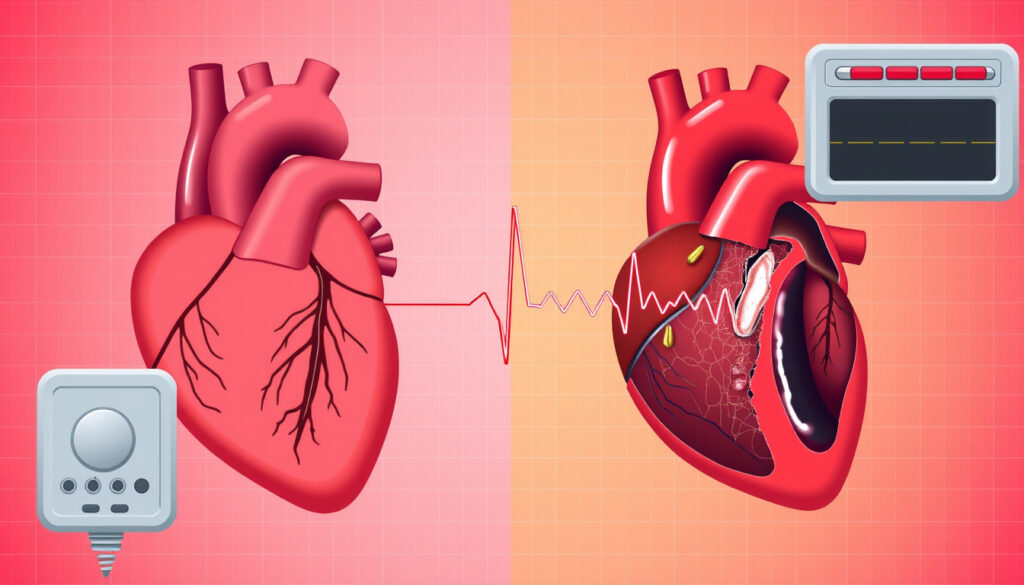
Cardiac Arrest vs Heart Attack: Which Is More Serious
Most people use the terms “heart attack” and “cardiac arrest” as if they’re the same emergency. They aren’t. One is a plumbing failure, the other an electrical meltdown — and knowing which is which can mean the difference between walking away and not surviving.
Cardiac arrest survival (out-of-hospital): ~10% ·
Heart attack survival (prompt treatment): >90% ·
Annual heart attacks in the US: ~805,000 ·
Annual sudden cardiac arrest deaths in the US: ~350,000
Quick snapshot
- Plumbing problem: blocked artery cuts blood flow to heart muscle (NHS (UK national health authority))
- Symptoms: chest pain, shortness of breath, nausea, sweating (Cleveland Clinic (cardiology specialty center))
- Treatment: medications, angioplasty, stenting (Mercy Health (hospital system blog))
- Electrical problem: heart stops beating unexpectedly (Heart Foundation (Australia’s heart health authority))
- Symptoms: sudden collapse, no pulse, no breathing (Heart Foundation (Australia’s heart health authority))
- Treatment: immediate CPR and defibrillation; treat underlying cause (Mayo Clinic (leading US medical center))
- Early warning signs of cardiac arrest are subtle and often missed entirely until collapse (American Heart Association (US cardiovascular authority))
- The precise trigger for the electrical disturbance in many cardiac arrest cases remains unidentified (American Heart Association (US cardiovascular authority))
- Each minute without treatment after cardiac arrest lowers survival by about 10% (National Academies of Sciences, Engineering, and Medicine (US science advisory body))
- CPR within 3–5 minutes plus AED can push survival above 60% (Heart Foundation (Australia’s heart health authority))
Eight key facts that draw the line between these two cardiac events.
| Fact | Heart Attack | Cardiac Arrest |
|---|---|---|
| Core mechanism | Blocked coronary artery chokes off blood flow to heart muscle (NHS (UK national health authority)) | Electrical malfunction causes the heart to stop beating effectively (Heart Foundation (Australia’s heart health authority)) |
| Onset speed | Gradual — symptoms build over hours or even days (Cleveland Clinic (cardiology specialty center)) | Sudden — collapse within seconds (Heart Foundation (Australia’s heart health authority)) |
| Consciousness | Usually conscious initially (Cleveland Clinic (cardiology specialty center)) | Immediate loss of consciousness (Heart Foundation (Australia’s heart health authority)) |
| Breathing | Breathing present but may be labored (Cleveland Clinic (cardiology specialty center)) | No normal breathing or only gasping (Heart Foundation (Australia’s heart health authority)) |
| Pulse | Pulse usually present (Cleveland Clinic (cardiology specialty center)) | No pulse (Heart Foundation (Australia’s heart health authority)) |
| Primary treatment | Restore blood flow via angioplasty, stents, or clot-busting drugs (NHS (UK national health authority)) | Immediate CPR and defibrillation with an AED (Mayo Clinic (leading US medical center)) |
| Out-of-hospital survival rate | >90% with prompt treatment (Mercy Health (hospital system blog)) | ~10% in the US (American Red Cross (US emergency response organization)) |
| Annual US cases | ~805,000 (American Heart Association (US cardiovascular authority)) | ~350,000 (American Heart Association (US cardiovascular authority)) |
Which is More Serious: Heart Attack or Cardiac Arrest?
What makes cardiac arrest more immediately life-threatening?
- Cardiac arrest stops blood flow to the brain and vital organs instantly. Without CPR and defibrillation, death occurs within minutes (Mayo Clinic (leading US medical center)).
- Each minute without treatment drops survival by roughly 10% (National Academies of Sciences, Engineering, and Medicine (US science advisory body)).
- The Heart Foundation (Australia’s heart health authority) notes that cardiac arrest typically causes sudden collapse with no pulse and no normal breathing — there is no gradual warning.
“Sudden cardiac arrest is an emergency that needs immediate CPR and defibrillation to prevent death.”
— Mayo Clinic (leading US medical center)
Cardiac arrest kills the brain within 4–6 minutes of lost blood flow. The victim cannot call for help, cannot signal distress. For bystanders, the decision to act — starting CPR, grabbing an AED — is the only thing standing between survival and death.
The implication: cardiac arrest compresses the survival window to minutes, while heart attack leaves time for hospital care.
Why is heart attack often less immediately fatal?
- A heart attack occurs when a blocked coronary artery starves part of the heart muscle of oxygen (NHS (UK national health authority)). The heart usually keeps beating, so blood continues to reach the brain.
- Most heart attack victims remain conscious and can seek help. The Cleveland Clinic (cardiology specialty center) lists chest pressure, shortness of breath, nausea, and sweating as common symptoms — all of which give time to call 911.
- With prompt treatment, survival exceeds 90% (Mercy Health (hospital system blog)).
The takeaway: a heart attack is serious but rarely fatal on the spot. Cardiac arrest is fatal within minutes unless someone nearby acts. The two conditions are not the same emergency, and treating them as interchangeable costs lives.
What Causes Cardiac Arrest?
What is the most common cause of cardiac arrest?
- Coronary artery disease — the buildup of plaque in the arteries that feed the heart — is the leading trigger. When a heart attack damages heart tissue, it can create the electrical instability that tips into cardiac arrest (Heart Foundation (Australia’s heart health authority)).
- The American Heart Association (US cardiovascular authority) estimates that about 350,000 out-of-hospital cardiac arrests occur each year in the US, and the majority are linked to underlying coronary artery disease.
What are other triggers?
- Cardiomyopathy — thickened or enlarged heart muscle that disrupts electrical signals (Mayo Clinic (leading US medical center)).
- Electrolyte imbalances — abnormal levels of potassium, magnesium, or calcium that interfere with the heart’s natural pacing.
- Drug overdoses, electrocution, drowning, and severe trauma can trigger cardiac arrest even in a structurally normal heart.
“Heart attack and sudden cardiac arrest are two different conditions.”
— American Heart Association (US cardiovascular authority)
A heart attack can set the stage for cardiac arrest, but cardiac arrest can strike someone with no known heart disease. The triggers are broader — and often less predictable — than most people realize.
The pattern: heart disease makes you vulnerable, but cardiac arrest can strike anyone.
How to Detect Cardiac Arrest Early?
What are the 5 warning signs of cardiac arrest?
- The Heart Foundation (Australia’s heart health authority) lists sudden collapse, loss of consciousness, no normal breathing, no pulse, and sometimes gasping or seizure-like movements as the primary signs.
- Hours before cardiac arrest, some people experience chest discomfort, shortness of breath, weakness, palpitations, or fainting episodes (American Heart Association (US cardiovascular authority)).
What are the four signs your heart is quietly failing?
- Fatigue and reduced exercise tolerance — the heart can’t keep up with demand.
- Shortness of breath during minimal activity or while lying flat.
- Swelling in the ankles, feet, or legs from fluid buildup.
- Persistent cough or wheezing with frothy sputum — a sign of fluid in the lungs.
These signs point to heart failure, which increases the risk of sudden cardiac arrest. The catch: many people dismiss them as aging or being out of shape.
How to Avoid Cardiac Arrest and Heart Attack?
Lifestyle changes to prevent a heart attack
- Quit smoking — it is the single most preventable cause of heart disease.
- Maintain healthy blood pressure (<120/80) and cholesterol levels (LDL under 100 mg/dL).
- Eat a diet rich in vegetables, whole grains, and lean protein while limiting saturated fat and sodium.
- Exercise at least 150 minutes per week at moderate intensity — brisk walking counts.
The NHS (UK national health authority) emphasizes that managing these risk factors dramatically cuts the likelihood of a first heart attack — and, by extension, reduces the substrate for cardiac arrest.
Emergency preparedness: CPR and AED training
- Immediate CPR can triple the chance of survival in sudden cardiac arrest (American Red Cross (US emergency response organization)).
- When CPR and an AED are used within the first 3–5 minutes, survival can rise above 60% in some settings (Heart Foundation (Australia’s heart health authority)).
- According to a PubMed Central (NIH research repository) review, in-hospital cardiac arrest survival to discharge is around 25%, and about 85% of survivors have favorable neurological outcomes — a strong argument for getting trained.
“Starting bystander CPR within 10 minutes of cardiac arrest may improve survival.”
— American Heart Association (US cardiovascular authority)
The pattern: prevention of heart attack is largely about daily habits. Prevention of cardiac arrest death is largely about bystander readiness. They require different strategies, and both are teachable.
Cardiac Arrest vs Heart Attack: Survival Rate and Outcomes
Is cardiac arrest a quick death?
- Yes — without intervention. The National Academies of Sciences, Engineering, and Medicine (US science advisory body) reports that survival decreases by about 10% for every minute without treatment. After 10 minutes without CPR or defibrillation, survival is near zero.
- But a quick death is not inevitable. The Heart Foundation (Australia’s heart health authority) notes that immediate CPR and AED use can push survival above 60% when delivered within 3–5 minutes.
What is the survival rate for cardiac arrest?
- Out-of-hospital cardiac arrest survival in the US is about 10% (American Red Cross (US emergency response organization)). Some older national data placed it under 6%.
- In-hospital cardiac arrest survival to discharge is around 25% in recent registry data (PubMed Central (NIH research repository)).
- The Heart Foundation (Australia’s heart health authority) reports Australia sees over 32,000 cardiac arrests annually with a 10% survival rate.
How does survival rate compare to heart attack?
- Heart attack survival exceeds 90% when patients receive prompt treatment (Mercy Health (hospital system blog)). The gap is enormous.
- The American Red Cross (US emergency response organization) reports a 10.5% survival to hospital discharge for EMS-treated out-of-hospital cardiac arrest in the US — roughly one-tenth the survival rate of a treated heart attack.
Cardiac Arrest vs Heart Attack: Side-by-Side Comparison
Five dimensions, one clear divide: electrical vs mechanical failure.
| Dimension | Heart Attack | Cardiac Arrest |
|---|---|---|
| Type of problem | Circulation block (plumbing) | Electrical malfunction (wiring) |
| Heart action | Still beating — often irregularly | Stopped or quivering (VF) |
| Victim status | Awake, can talk, feels chest pain | Unconscious, not breathing, no pulse |
| Key survival factor | Getting to a hospital fast | Getting CPR and AED immediately |
| Window for best outcome | Hours | Minutes |
The trade-off: heart attack gives you time but requires recognizing subtle symptoms. Cardiac arrest gives you no time but rewards brute-force action — push hard and fast on the chest.
Confirmed Facts vs What’s Still Unclear
Confirmed facts
- Cardiac arrest and heart attack have fundamentally different mechanisms — electrical vs plumbing (Heart Foundation (Australia’s heart health authority)).
- Cardiac arrest is more immediately life-threatening because it stops blood flow to the brain (Mayo Clinic (leading US medical center)).
- Immediate CPR can triple survival from cardiac arrest (American Red Cross (US emergency response organization)).
- Out-of-hospital cardiac arrest survival is approximately 10% in the US and Australia (American Red Cross (US emergency response organization); Heart Foundation (Australia’s heart health authority)).
What’s still unclear
- Early warning signs of cardiac arrest are subtle — many victims experience no symptoms at all before collapsing, making prediction difficult (American Heart Association (US cardiovascular authority)).
- The exact mechanism that flips a stable heart rhythm into a fatal arrhythmia remains poorly understood in many individual cases.
- Whether certain over-the-counter supplements or lifestyle interventions can meaningfully reduce sudden cardiac arrest risk beyond standard heart disease prevention is not well established by controlled trials.
What You Need to Know: Fast Facts for Everyday Life
For patients, the distinction between cardiac arrest and heart attack changes what you do in the moment. For family members, it changes what you learn. For bystanders, it changes what you’re willing to try.
- If someone collapses suddenly, is unresponsive, and isn’t breathing normally: call 911, start CPR, and find an AED. That’s cardiac arrest until proven otherwise. Do not wait for paramedics to arrive — American Red Cross (US emergency response organization) data shows CPR can triple survival odds.
- If someone has chest pressure, shortness of breath, nausea, or sweating: call 911, have them sit down and stay calm. That’s likely a heart attack. The heart is still pumping, but time is muscle — NHS (UK national health authority) stresses that early treatment saves heart tissue.
- If you are at risk for heart disease: get your blood pressure and cholesterol checked, stop smoking, and ask your doctor about your personal risk for both conditions. The same lifestyle changes protect against both.
For the estimated 1 in 3 adults worldwide with undiagnosed heart disease risk factors, the choice is clear: learn CPR, recognize the difference, and act fast — or risk becoming a statistic.
Frequently Asked Questions
Can a heart attack lead to cardiac arrest?
Yes. A heart attack can cause scar tissue or electrical instability that triggers a fatal arrhythmia. This is why a heart attack is a major risk factor for sudden cardiac arrest (Heart Foundation (Australia’s heart health authority)).
What should I do if someone collapses suddenly?
Call 911 immediately, check for responsiveness and normal breathing. If the person is not breathing or only gasping, start hands-only CPR at 100–120 compressions per minute and, if available, use an AED as soon as it arrives (Mayo Clinic (leading US medical center)).
Is CPR effective for both cardiac arrest and heart attack?
CPR is only appropriate for cardiac arrest, when the heart has stopped beating. For a conscious heart attack victim with a pulse, CPR is not needed — call 911 and keep them calm. However, if a heart attack victim loses consciousness and stops breathing normally, start CPR immediately.
What is the difference between cardiac arrest and stroke?
Cardiac arrest is an electrical failure of the heart that stops blood flow entirely. A stroke is caused by a blocked or ruptured blood vessel in the brain. In a stroke, the heart is still beating, but brain tissue dies from lack of oxygen. Both are emergencies, but the immediate response differs.
How long does it take to die from cardiac arrest?
Without CPR or defibrillation, brain damage begins within 4–6 minutes, and death typically occurs within 10 minutes. Each minute without treatment reduces survival by about 10% (National Academies of Sciences, Engineering, and Medicine (US science advisory body)).
Can cardiac arrest be reversed?
Yes, but only if someone starts CPR and uses a defibrillator quickly. The heart can be shocked back into a normal rhythm if the intervention happens within minutes. After that window, the chances drop sharply (Mayo Clinic (leading US medical center)).
Are there any warning signs hours before cardiac arrest?
Some people report chest discomfort, shortness of breath, palpitations, weakness, or fainting in the hours before cardiac arrest. But many have no warning at all. Early detection remains a challenge, which is why the American Heart Association (US cardiovascular authority) emphasizes bystander training over prediction.
For further reading: Lung Cancer Survival Rate: A Complete Guide by Stage and Age and Complex Regional Pain Syndrome: Symptoms, Causes & Treatment — two related health guides that cover survival statistics and condition comparisons in similar depth.
More related posts
 Andy Richter Movies and TV Shows: Full Filmography & Career Guide
 Shalom Brune-Franklin: Biography, Nationality, Movies
 Other Words for Because: 30+ Synonyms & Alternatives
 Air Fry Pork Chops: Perfect Time & Temp for Juicy Results
 What Time Is Sunset Tonight in Ireland? Complete Guide
 Like a Dragon Infinite Wealth Review: Worth It in 2025
 Panda Express Near Me: No UK or Ireland Locations Yet
 $1,600 Stimulus 2025 Eligibility: Who Qualifies