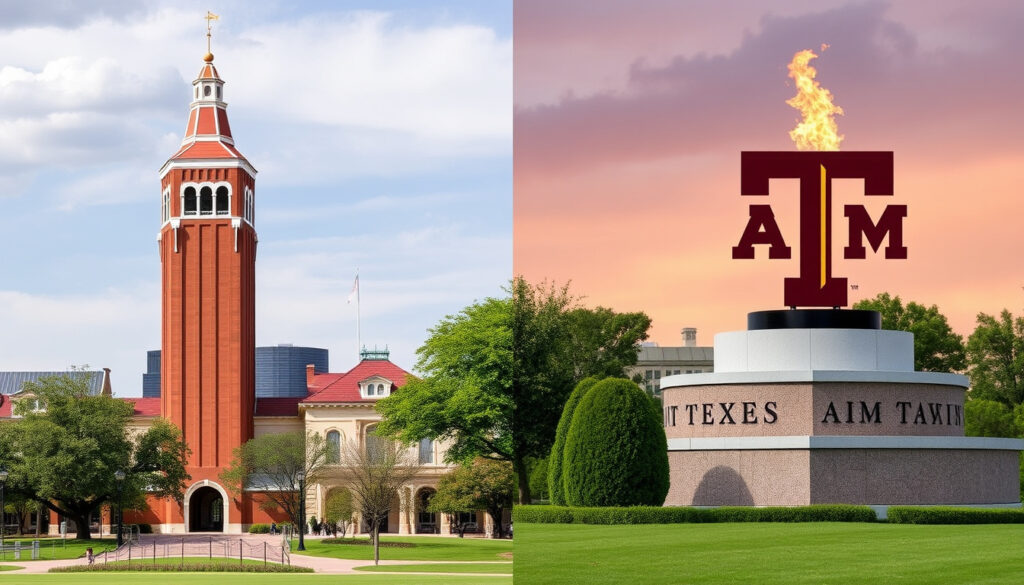
UT vs A&M: Which School Is Better? Full Comparison
If you’ve ever tried to pick between burnt orange and maroon, you know the question goes deeper than a color preference. UT Austin and Texas A&M are two of the biggest, most respected public universities in the country, but they offer very different experiences.
UT Austin undergraduate enrollment (fall 2023): 41,309 ·
Texas A&M undergraduate enrollment (fall 2023): 57,512 ·
UT Austin acceptance rate (2024): 29% (approx.) ·
Texas A&M acceptance rate (2024): 63% (approx.) ·
UT Austin U.S. News ranking (2024): #32 (National Universities) ·
Texas A&M U.S. News ranking (2024): #47 (National Universities)
Quick snapshot
- UT Austin acceptance rate is lower than Texas A&M’s (Esslo, college comparison)
- Texas A&M has larger total enrollment (CollegeSimply, enrollment data)
- Texas leads the football series 78–37–5 (Wikipedia, rivalry history)
- Both are public, research-intensive, SEC members since 2024 (Wikipedia, rivalry history)
- Which university is “better” overall — depends on program and fit (Empowerly, admissions guide)
- Exact application numbers for 2025 may vary across sources (Esslo, college comparison)
- Rivalry resumed 2024 after 12-year pause (Wikipedia, rivalry history)
- Texas won the 2025 matchup 27–17 (ESPN, game recap)
- Next game: November 27, 2026 at Kyle Field (Wikipedia, rivalry history)
- Both programs now in SEC, regular annual meetings likely (Wikipedia, rivalry history)
The comparison table below captures the core metrics side by side.
| Attribute | UT Austin | Texas A&M |
|---|---|---|
| Location | Austin, TX | College Station, TX |
| Nickname | Longhorns | Aggies |
| U.S. News Rank (2024) | #32 (National Universities) | #47 (National Universities) |
| Acceptance Rate | ~29% | ~63% |
| Enrollment (undergrad) | 41,309 | 57,512 |
| All-Time Football Series | Leads 78–37–5 | Trails 37–78–5 |
Which is better, Texas A&M or UT?
Academic reputation comparison
Three numbers tell a big part of the story. UT Austin ranks #32 nationally and #9 among public universities; Texas A&M sits at #47 and #22 among publics, according to Empowerly, an admissions guide citing 2026 U.S. News rankings. In law school rankings, UT Austin’s law school is #16, while A&M’s is #22 — again, UT leads according to LSD Law, a legal education comparison site.
The real difference is in strengths. UT Austin is known for top-tier programs in liberal arts, business (McCombs School of Business), and law. Texas A&M excels in engineering, agriculture, and military science, with a deep tradition through the Corps of Cadets.
If you want a broader liberal arts foundation with a nationally ranked law school nearby, UT pulls ahead. If engineering or agriculture is your path, A&M’s focused resources and deep industry ties give it an edge.
The pattern: UT Austin holds stronger overall national rankings, while A&M dominates in specific technical fields.
Is it harder to get into UT or Texas A&M?
Admission rates comparison
- UT Austin’s acceptance rate is roughly 26–29% versus Texas A&M’s 51–63%, based on multiple independent sources (Esslo, college comparison) and (CollegeSimply, enrollment database).
- In one cited cycle, UT Austin received ~66,109 applications and admitted ~19,253; Texas A&M received ~50,832 and admitted ~32,149 (CollegeSimply, application data).
- UT Austin is consistently described as the more selective admit (Esslo, college comparison).
The 90% rule at UT Austin
UT Austin uses the top 6% automatic admission rule, not the 90% rule. Under Texas Education Code section 51.803, Texas high school students who graduate in the top 6% of their class are automatically admitted — though not necessarily to their preferred major. The competition of the major itself is a significant factor in final admission (University of Texas Admissions, official review policy).
Texas A&M’s auto-admit threshold remains top 10% for Texas residents, according to Empowerly, an admissions guide.
Is Texas A&M bigger than UT?
Undergraduate enrollment sizes
- Texas A&M’s total enrollment is roughly 74,000 versus UT Austin’s 52,000 (CollegeSimply, size comparison).
- Undergraduate enrollment: Texas A&M ~57,512; UT Austin ~41,309.
- The A&M campus in College Station is also larger by acreage — about 5,500 acres compared to UT’s 431-acre main campus.
- Both are among the largest universities in the U.S. by student population.
The catch: Larger enrollment at A&M means bigger class sizes and a broader alumni network, but can also mean less individualized attention in lectures.
What is the difference between Texas and Texas A&M?
Campus culture and traditions
- UT Austin is urban, liberal-leaning, located in Austin — a major city with a thriving tech scene and music culture.
- Texas A&M is based in College Station, a smaller, more conservative town, with strong military traditions through the Corps of Cadets and the 12th Man fan culture.
- Both moved to the SEC for athletics starting in 2024, intensifying their rivalry.
Academic offerings
- UT Austin: strong in business (McCombs), law, liberal arts, engineering (Cockrell School), and natural sciences.
- Texas A&M: leading in engineering (Dwight Look College), agriculture, veterinary medicine, and military science.
Sports rivalry
- All-time football series: Texas leads 78–37–5 (Wikipedia, rivalry history).
- The rivalry paused for 12 years after A&M left the Big 12 for the SEC in 2012.
- The game resumed November 28, 2025, with Texas winning 27–17 (ESPN, game recap Dec 1, 2025).
The next game is set for November 27, 2026 at Kyle Field in College Station — and with both schools now in the SEC, annual meetings are expected to become permanent again.
The implication: The choice between UT and A&M comes down to whether you prefer an urban, liberal arts-focused environment or a traditional, engineering-and-military-oriented campus.
Is UT Austin considered prestigious?
Yes — UT Austin is widely regarded as a Public Ivy, consistently ranked in the top 50 nationally. It has strong graduate programs, a billion-dollar research enterprise, and a highly selective admissions process. Its alumni network includes 13 Nobel laureates and numerous Fortune 500 CEOs.
The pattern: UT Austin’s academic reputation is strongest in the liberal arts, business, and law; Texas A&M’s influence is deeper in engineering and agriculture. Neither school lacks prestige — they just have different lanes.
Timeline: The UT vs A&M rivalry
The rivalry history shows key turning points.
| Year | Event |
|---|---|
| 1894 | First football game; Texas wins 38–0 (Wikipedia, rivalry history) |
| 1990s–2010s | Annual rivalry known as the Lone Star Showdown |
| 2012 | A&M leaves Big 12 for SEC; rivalry pauses |
| 2024 | Texas joins SEC; rivalry resumes tentatively |
| Nov 28, 2025 | Texas wins 27–17 in revival game (ESPN, game recap) |
| Nov 27, 2026 | Next scheduled game at Kyle Field |
The pattern: The rivalry has deep historical roots, and SEC membership now guarantees regular matchups going forward.
Upsides and downsides of each school
Upsides
- UT: Stronger national rankings in liberal arts, business, law; urban location; selective reputation
- A&M: Larger alumni network; excellence in engineering and agriculture; strong military tradition
- Both: SEC membership provides national sports exposure
Downsides
- UT: Higher selectivity makes admission harder; large class sizes; competitive major caps
- A&M: Lower overall selectivity may be seen as less prestigious; less urban campus experience
- Both: Can feel impersonal due to size; high in-state competition for auto-admit
“Texas Longhorns won 27-17, earning their first win over the Aggies since 2011.”
— ESPN, game recap Dec 1, 2025
“UT Austin is consistently the more selective admit than Texas A&M.”
— Esslo, college comparison
“The top 6% automatic admission rule guarantees a spot, but not necessarily in your chosen major.”
— Esslo, UT Austin admissions summary
“Texas A&M’s auto-admit threshold remains top 10% for Texas residents.”
— Empowerly, admissions guide
The takeaway is concrete: for an in-state student aiming at business or law, UT Austin’s prestige and selectivity justify the tougher odds. For an engineering or agriculture-focused student, A&M’s focused resources and larger cohort offer a practical advantage. For a Texas sports fan, the renewed annual rivalry is a win no matter which color sweatshirt you wear.
Related reading: **Best Stocks to Buy Right Now 2026: Top Picks Compared** · **NFL Strength of Schedule 2025: Easiest & Toughest Teams**
quantadmit.com, esslo.org, en.wikipedia.org, youtube.com, topschoolsrankings.com, niche.com, en.wikipedia.org
Frequently asked questions
Is UT Austin more prestigious than Texas A&M?
By most national rankings, yes. UT Austin is ranked #32 vs A&M’s #47 (U.S. News 2024). It’s considered a Public Ivy with stronger selectivity and a higher-profile alumni network in business, law, and government.
What is the 90% rule at UT Austin?
There is no 90% rule. UT Austin uses the top 6% automatic admission rule for Texas high school students, not 90%.
Which university is better for engineering, UT or A&M?
Texas A&M’s Dwight Look College of Engineering is larger and more focused, with deep ties to agriculture and defense industries. UT Austin’s Cockrell School of Engineering is also highly ranked but smaller. A&M has the edge in size and resources for engineering specifically.
Do UT and Texas A&M play every year now?
Since 2024, both schools are in the SEC, making annual football matchups likely. The 2025 game was the first since 2011. The next scheduled game is November 27, 2026.
How can I get tickets for the UT vs A&M game?
Official tickets are sold through each university’s athletic department. Secondary marketplaces like StubHub and Vivid Seats also list tickets, often at higher prices for rivalry games.
Is UT Austin harder to get into than Texas A&M?
Yes. UT Austin’s acceptance rate is around 26–29%, while Texas A&M’s is around 51–63%. UT also uses major-specific competition, making admission more competitive overall.
What are the main differences in campus culture between UT and A&M?
UT Austin is urban, liberal, and located in a major city (Austin). Texas A&M is more conservative, in a smaller town (College Station), and has strong military traditions through the Corps of Cadets.
More related posts
 Dune Part 3 Release Date: Confirmed December 2026
 Is Charlie Kirk’s Wife Pregnant – Rumors Debunked
 Portuguese Man o’ War: Sting, Biology & Jellyfish Difference
 Jane Austen Wrecked My Life – Plot Summary, Themes and Facts
 Symptoms of a Stroke: 5 Warning Signs and FAST Test
 Dancing with the Stars Season 34 – Premiere, Cast & Winner
 Dodgers vs Padres Match Player Stats: 2026 Series Breakdown
 Den of Thieves 2: Pantera – Release, Streaming & Review