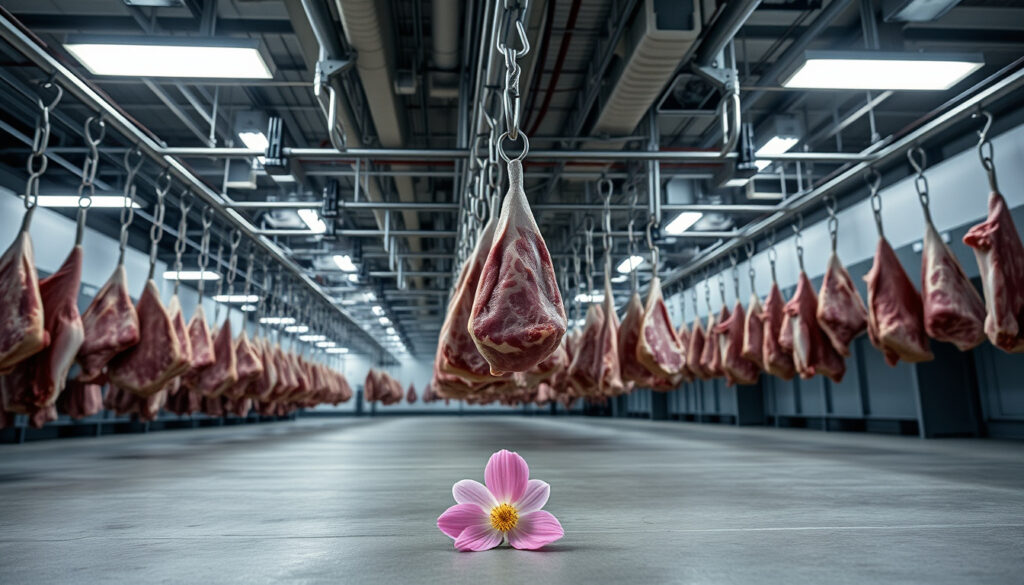
Tender Is the Flesh: Plot, Ending & Meaning
You’ve seen Tender Is the Flesh on every “most disturbing books” list, and the buzz is earned: this Argentine dystopian novel doesn’t just shock — it forces you to stare at the mechanics of a society that has made cannibalism legal, efficient, and mundane. Here’s everything you need to know about its plot, its gut-punch of an ending, and what the book is really trying to say.
Author: Agustina Bazterrica ·
Original publication year: 2017 (Spanish), 2020 (English translation) ·
Genre: Dystopian horror, literary fiction ·
Page count (English edition): 224 pages ·
Goodreads rating: 4.1 / 5 (over 200,000 ratings) ·
Setting: Near-future dystopia where a virus contaminates all animal meat
Quick snapshot
- Agustina Bazterrica is the author (Wikipedia (encyclopedic overview))
- The novel was originally published in 2017 (Wikipedia)
- Cannibalism is legal after a virus makes animal meat inedible (Wikipedia)
- Marcos works at a human processing plant (Wikipedia)
- The exact nature of the virus is never specified (Trish Talks Books (book blog))
- The timeline of the pandemic is left vague (Trish Talks Books)
- The world’s fate after the ending is ambiguous (Baddie Book Reviews (reader review site))
- 2017: Original Spanish publication (Wikipedia)
- 2020: English translation by Pushkin Press (Wikipedia)
- 2020–2024: Viral popularity on social media and Goodreads (Scribner Books TikTok (publisher’s social media))
- No sequel has been announced (Wikipedia)
- Film adaptation rights were acquired but no production confirmed (Scribner Books TikTok)
- Discussion around the novel’s themes continues in literary circles (Baddie Book Reviews)
Below is a quick-reference table of essential publication details.
| Attribute | Value |
|---|---|
| Full title | Tender Is the Flesh |
| Author | Agustina Bazterrica |
| Original language | Spanish |
| English translator | Sarah Moses |
| Publisher (English) | Pushkin Press |
| Publication date (English) | 2020 |
| Page count | 224 |
| ISBN (English) | 978-1782276203 |
| Goodreads rating | 4.1 / 5 |
What is the point of Tender Is the Flesh?
The central ethical critique
The novel uses a literal cannibal economy to hold a mirror to industrial meat production. By making humans the commodity, Bazterrica forces readers to confront the same logic that turns animals into units of meat. As Wikipedia (encyclopedic overview) notes, the story depicts a society where animal meat is unavailable and cannibalism is legalized — a scenario that exaggerates but parallels real-world factory farming.
The system dehumanizes both the “heads” (the people bred for slaughter) and the workers. Marcos, the protagonist, is numb to the violence around him. The Trish Talks Books (book blog) review argues that the horror is not the gore but the normalization of it.
The trade-off: Bazterrica sacrifices subtlety for allegorical bluntness. Readers who stay with the novel may find themselves questioning the ethical distance between a slaughterhouse and a human processing plant.
How the novel mirrors real-world meat production
- The language of “special meat” and “heads” echoes the euphemisms used in animal agriculture (Wikipedia).
- Workers are conditioned to see their product as non-human, just as in actual slaughterhouses (Trish Talks Books).
- The “Transition” period in the book mirrors real regulatory shifts after food contamination crises (Baddie Book Reviews (reader review site)).
The implication: the novel’s point is not to shock but to ask whether a system that treats living beings as products can ever be ethical — and what happens when that system becomes all there is.
What is the plot of Tender Is the Flesh?
Setting and initial premise
The story is set in an unnamed country (likely Argentina) after a virus has contaminated all animal meat, making it unsafe to eat. The government, desperate to feed the population, legalizes the slaughter of humans for food. Wikipedia states that humans bred for consumption are called “heads” and their meat is marketed as “special meat.”
Main character Marcos
Marcos is a middle-aged man who works at a human processing plant. He is separated from his wife, Cecilia, and cares for his father, who suffers from dementia. Marcos goes through the motions at work, but he is not a true believer — he dislikes the system but doesn’t resist it. Trish Talks Books describes him as a “gray man” who has resigned himself to the horror.
The legalization of cannibalism
The “Transition” laws regulate everything from breeding to butchering. Those who are not considered “human” by the new legal definition can be farmed. Marcos’s job involves processing these individuals. Baddie Book Reviews notes that the procedural details are chilling precisely because they are bureaucratic.
The plot forces Marcos to navigate a system that demands his full complicity, even as his own humanity erodes.
What happened at the end of Tender Is the Flesh?
Marcos’s gift
Marcos is given a live woman as a gift from his bosses. He names her Jasmine and keeps her in his home, initially treating her with a semblance of care. His wife, Cecilia, discovers Jasmine and, surprisingly, helps care for her. Wikipedia says that Jasmine gives birth to a boy during the story.
The final twist
Wikipedia describes the ending: after Jasmine gives birth, Marcos claims the baby as his and Cecilia’s, then knocks Jasmine unconscious and carries her to the barn to slaughter her. Cecilia protests that Jasmine could have given them more children, but Marcos follows through. His final thought is that Jasmine “had the human look of a domesticated animal.”
GoodNovel (book community) adds context: Marcos’s wife had miscarried years earlier, and the baby becomes a replacement for that loss — but only after he kills the mother.
The pattern: the reader is led to believe Marcos might be different, but the ending reveals he has fully internalized the system’s dehumanization.
What is the twist in Tender Is the Flesh?
The nature of the twist
The twist is that Marcos does not save Jasmine — he kills her. Throughout the novel, he seems to be a reluctant participant, and when he brings Jasmine home, it appears he might be trying to protect her. But in the final pages, Bazterrica subverts that hope entirely. GoodNovel argues the twist is not shock for shock’s sake but a commentary on how cruelty normalizes.
Reader expectations vs. reality
- We expect a redemption arc → Marcos commits murder.
- We expect sympathy for Jasmine → Marcos sees her as livestock.
- We expect the system to be challenged → the system wins.
Baddie Book Reviews calls the ending “cold and unsurprising given the book’s moral universe.” The twist is effective because it feels inevitable in hindsight.
The twist works only if the reader has been hoping for a different outcome. That hope is exactly what Bazterrica exposes as naive complicity.
The twist redefines the novel’s entire moral trajectory—it’s not about one man’s redemption but about the inevitability of complicity.
What is a brief summary of Tender Is the Flesh?
Core narrative arc
Wikipedia (encyclopedic overview) summarizes it succinctly: in a world where a virus has made all animal meat inedible, cannibalism is legalized. Marcos, a worker in a human processing plant, is given a live woman as a gift. He keeps her, names her Jasmine, and after she gives birth, he butchers her himself.
Key themes
- Dehumanization: The system strips humans of their personhood (Trish Talks Books).
- Consumer complicity: Ordinary people buy “special meat” without questioning its source (Baddie Book Reviews).
- Morality under capitalism: When profit is the only value, ethics become optional (GoodNovel).
What this means: the novel is not about cannibalism per se — it’s about how any atrocity can be normalized when it’s profitable and regulated.
Confirmed facts
- The novel was written by Agustina Bazterrica (Wikipedia).
- Animal meat is contaminated by a virus (Wikipedia).
- Marcos works at a human slaughterhouse (Wikipedia).
- Jasmine gives birth to a boy (Wikipedia).
- Marcos kills Jasmine at the end (Wikipedia).
What’s unclear
- The exact virus that caused the meat contamination is never named (Trish Talks Books).
- It’s not clear how far the pandemic has spread geographically (Trish Talks Books).
- What happens to the baby after the ending is ambiguous (Baddie Book Reviews).
- Whether Marcos faces any consequences is left open (GoodNovel).
Quotes from readers and critics
“The ending of Tender Is the Flesh is not shock for shock’s sake but a commentary on how cruelty normalizes.”
— GoodNovel analysis (GoodNovel (book community))
“Marcos’s final act is cold and unsurprising given the book’s moral universe.”
— Baddie Book Reviews (Baddie Book Reviews (reader review site))
“The horror of the novel lies not in the gore but in the bureaucratic language used to describe the slaughter.”
— Trish Talks Books (Trish Talks Books (book blog))
The trade-off: these interpretations all agree that the novel’s power comes from its unwavering commitment to its premise. For readers who finish the book, the takeaway is not just a story about cannibalism — it’s a mirror held up to their own relationship with the meat they consume.
For the reader who has just finished Tender Is the Flesh and needs to process what they’ve read, the choice is clear: sit with the discomfort and ask yourself which parts of the system you’re already participating in, or turn away and pretend the mirror isn’t there.
Frequently asked questions
Is Tender Is the Flesh based on a true story?
No. It is a work of fiction by Agustina Bazterrica (Wikipedia).
Why is the book called Tender Is the Flesh?
The title is a reference to a line in a poem by Robert Southwell, often interpreted as a commentary on the vulnerability and commodification of the body (GoodNovel).
Is Tender Is the Flesh a horror novel?
Yes, it is classified as dystopian horror and literary fiction (Wikipedia).
How long does it take to read Tender Is the Flesh?
The English edition is 224 pages. Most readers finish it in 4–6 hours (Baddie Book Reviews).
Is there a sequel to Tender Is the Flesh?
No sequel has been announced (Wikipedia).
What awards has Tender Is the Flesh won?
It won the Premio Clarín Novela award in 2017 (Wikipedia).
Is Tender Is the Flesh appropriate for young readers?
No. It contains graphic violence, sexual content, and disturbing themes. It is intended for adult readers (Trish Talks Books).
More related posts
 Was Nancy Guthrie Found – Latest Status and Key Facts
 What Doe LMAO Mean? Definition, U age, and I It a Swear Word?
 Shalom Brune-Franklin: Biography, Nationality, Movies
 Best Weighted Vest for Women: Health & Safety Guide
 What Month Is June? Calendar, Observances, Symbols & More
 How Great Thou Art Lyrics: History, Meaning & Best Versions
 Symptoms of a Stroke: 5 Warning Signs and FAST Test
 Area of a Square – Formula and Calculation Guide