Where Is New England – Map, States List, Location & Facts
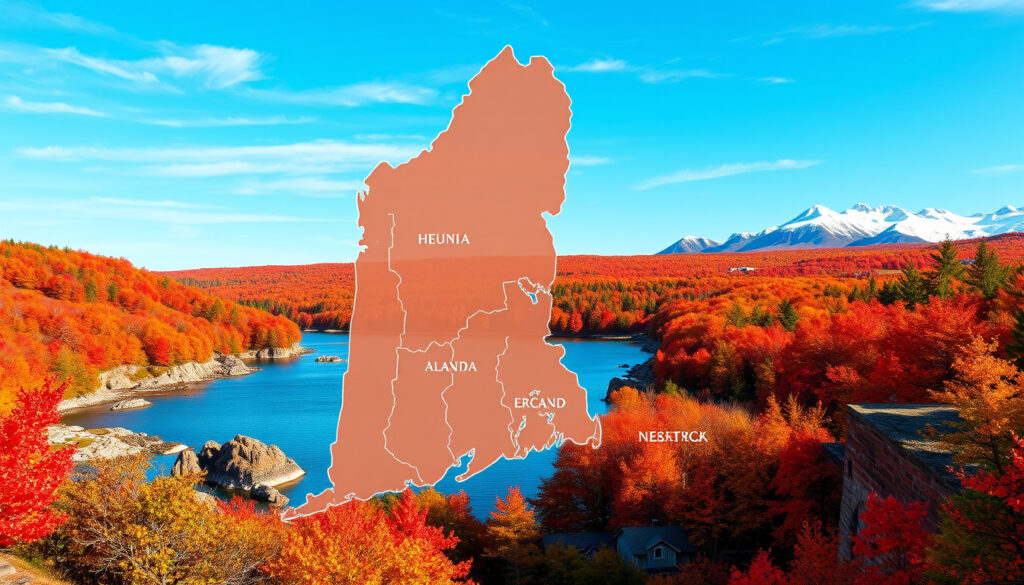
New England refers to a distinct geographic region located along the northeastern coast of the United States. Despite its compact size, the area encompasses six states, each with unique characteristics while sharing common cultural and historical ties. Understanding New England’s location and composition requires examining both its geographic boundaries and the states that comprise it.
The region occupies a strategic position between Canada to the north and the Atlantic Ocean to the east and south. It sits east of New York State, which forms its western boundary, and north of Long Island Sound, which borders it to the southwest. This positioning has shaped New England’s development, from early colonial settlement patterns to modern economic and cultural connections.
Many people outside the United States associate New England with autumn foliage, distinctive accents, and colonial history, but precisely locating the region on a map requires specific geographic knowledge. The distinction between New England and neighboring regions like the Mid-Atlantic often causes confusion, particularly regarding New York’s status relative to the six-state definition.
Where Is New England Located?
New England occupies the northeastern corner of the United States, extending from the Canadian border southward along the Atlantic coastline. The region spans approximately 71,987 square miles (186,500 km²), making it one of the smaller regional divisions in the country by area. Despite this relatively modest footprint, the six states that comprise New England contain a combined population exceeding 15 million residents, reflecting population density significantly above the national average.
The U.S. Census Bureau recognizes New England as one of its nine regional divisions, providing official boundaries that distinguish it from adjacent regions. This official designation helps clarify common misconceptions about where the region begins and ends geographically.
- The region comprises exactly six states, a definition that has remained consistent since the early 19th century
- Canada borders the region to the north and northeast, creating significant cross-border connections
- The Atlantic Ocean and Gulf of Maine form the eastern coastline, while Long Island Sound borders the southwestern portion
- Population density averages 234.93 persons per square mile, substantially higher than the national average of 79.56
- Southern states (Connecticut, Massachusetts, Rhode Island) contain approximately 75% of the regional population
- Boston serves as the primary metropolitan hub with approximately 675,000 residents
| State | Capital | Area (km²) | Population (2020) |
|---|---|---|---|
| Connecticut | Hartford | 14,357 | 3,563,077 |
| Maine | Augusta | 91,633 | 1,345,790 |
| Massachusetts | Boston | 27,337 | 6,976,597 |
| New Hampshire | Concord | 24,214 | 1,371,246 |
| Rhode Island | Providence | 3,144 | 1,056,161 |
| Vermont | Montpelier | 24,923 | 628,061 |
What States Make Up New England?
The six states that constitute New England are, from north to south: Maine, New Hampshire, Vermont, Massachusetts, Rhode Island, and Connecticut. This roster has remained unchanged since 1820, when Maine separated from Massachusetts to become an independent state. The combination of these six distinct political entities creates a region with remarkable diversity in landscape, economy, and culture while maintaining shared historical roots.
Northern States: Maine, New Hampshire, and Vermont
Maine occupies the northeasternmost position in the United States, making it both the largest New England state by area and the easternmost state in the country. The state’s 91,633 square kilometers encompass vast forests, a jagged coastline, and extensive borders with Canada. Its capital, Augusta, sits along the Kennebec River in the southern portion of the state. Maine’s population of approximately 1.35 million reflects its largely rural character, with population density of only 63.56 persons per square mile.
New Hampshire lies directly west of Maine, sharing a border that stretches approximately 16 miles along the state’s eastern edge. The state also borders Vermont to the west and Canada to the north, while its 18 miles of Atlantic coastline provide access to the Gulf of Maine. Concord serves as the state capital, though Portsmouth and Manchester represent larger population centers. New Hampshire’s population density of 151.8 persons per square mile reflects a mix of urban and rural areas.
Maine and Vermont joined the original four New England states at different times. Vermont achieved statehood in 1791 following a territorial dispute with New York, while Maine separated from Massachusetts in 1820 as part of the Missouri Compromise. This explains why early census records and historical maps sometimes depicted different configurations of New England.
Vermont represents the northwesternmost state in the region, distinguished as both landlocked and one of the least populous states in the entire United States. Montpelier, the state capital, holds the distinction of being the least populous state capital in the country. Vermont’s borders include New Hampshire to the east, New York to the west, and Canada to the north. The state’s 2020 population of 628,061 reflects steady growth through domestic migration and international immigration, though natural population decrease (more deaths than births) has required immigration to offset demographic losses.
Southern States: Massachusetts, Rhode Island, and Connecticut
Massachusetts anchors the southern portion of New England both geographically and demographically. As the most populous state in the region with nearly 7 million residents, Massachusetts contains the metropolitan area of Boston, which serves as the primary economic and cultural center for all six states. The state’s shape includes Cape Cod and the islands of Martha’s Vineyard and Nantucket, extending its Atlantic coastline significantly. Massachusetts also maintained colonial control over Maine until 1820, when that territory achieved separate statehood.
Rhode Island holds the distinction of being the smallest state by area in the entire United States, though it remains a fully independent member of both New England and the nation. Providence, the capital, represents the third-largest metropolitan area in New England after Boston and Hartford. The state’s 1,056,161 residents enjoy approximately 400 miles of coastline along Narragansett Bay and the Atlantic Ocean, contributing to a population density that rivals Massachusetts despite the state’s small geographic footprint.
Connecticut occupies the southwestern corner of New England, serving as the interface between the region and neighboring New York. Hartford, the capital, developed as an insurance industry hub, while coastal cities like New Haven (home to Yale University) and Stamford maintain strong economic ties to the New York metropolitan area. The state’s 3.56 million residents represent the second-largest population in New England, with a density of 786.83 persons per square mile reflecting substantial urbanization along the Long Island Sound shoreline.
What Are the Boundaries of New England?
New England’s boundaries are defined by natural geographic features and international borders rather than political lines drawn arbitrarily. To the north and northeast, Canada creates a clear international boundary that separates the region from Quebec and the Canadian maritime provinces. This border extends for hundreds of miles, crossing forests, mountains, and waterways that have shaped both trade relationships and cultural exchanges between the areas.
The Atlantic Coastline and Maritime Borders
The eastern and southern boundaries of New England follow the contours of the Atlantic Ocean, the Gulf of Maine, and Long Island Sound. These maritime borders have historically provided economic opportunities through fishing, shipping, and trade, while also creating distinct coastal cultures that differentiate New England from inland American regions. The Britannica encyclopedia notes that the Gulf of Maine specifically forms a significant embayment that influences climate, marine biology, and human settlement patterns throughout the northern portion of the region.
According to demographic research from the Carsey School of Public Policy at the University of New Hampshire, all six New England states have experienced population gains since 2000, though the growth mechanisms vary. Southern states like Connecticut and Massachusetts grew primarily through international immigration, while northern states like Maine and New Hampshire attracted domestic migrants in addition to international arrivals. Northern states have struggled with natural population decrease, requiring migration to maintain growth.
The New York Boundary and Common Misconceptions
Perhaps the most persistent misconception about New England concerns the status of New York State. New York is not part of New England. It serves instead as New England’s western boundary, separating the region from the Mid-Atlantic states. This distinction appears consistently in official census classifications, which place New York in a separate regional division from New England. The confusion likely arises because New York shares cultural, economic, and historical connections with the region, and many Americans use “New England” loosely to describe a broader northeastern area.
The boundary between New England and New York runs primarily along state lines, though the relationship between Vermont and New York played a significant role in Vermont’s path to statehood. Vermont’s admission to the Union in 1791 resolved a territorial dispute between New York and the self-declared Republic of Vermont, effectively establishing Vermont’s status as a New England state rather than an extension of New York’s territory. The historical context of this boundary dispute reinforces New England’s distinct identity separate from the Empire State.
Why Is the Region Called New England?
The name “New England” originated from Captain John Smith, who explored the region’s coastline in 1614 and formally proposed naming the territory “New England” in his 1616 pamphlet describing the area. The choice of this name explicitly connected the new territory to England, the colonizing nation’s homeland. King James I officially approved the name in 1619, making it the first colonial region in what would become the United States to receive an official English name reflecting its European origins.
Historical Context of the Name
When John Smith coined the term, the region had already hosted European visitors for over a century, including fishermen from England, France, Portugal, and Spain who had exploited the rich fishing waters of the North Atlantic. However, Smith’s detailed accounts and promotional writings helped establish “New England” as the standard designation for English colonial efforts in the area. The name distinguished this region from “New Spain” and “New France,” other colonial territories established by European powers on the North American continent.
The Pilgrim settlers who arrived aboard the Mayflower in 1620 further cemented the English character of the region through the establishment of Plymouth Colony. These early settlers brought with them cultural traditions, religious practices, and governance structures that would shape New England’s development for centuries. The combination of Smith’s naming, Plymouth’s founding, and subsequent waves of English migration established an enduring connection between the region and its European namesake that persists in the name’s continued use.
Size and Geographic Extent
The region’s total area of approximately 71,987 square miles (186,500 km²) makes New England smaller than many individual states in the western United States. For comparison, California alone spans nearly 164,000 square miles, while Texas exceeds 261,000 square miles. However, New England’s compact size contributes to its cohesive regional identity. Residents can travel from the metropolitan areas of southern New England to the remote wilderness of northern Maine within a day’s drive, experiencing dramatic changes in landscape, culture, and economy within a relatively short distance.
While New England’s official boundaries remain fixed, informal cultural perceptions sometimes extend the region’s identity into neighboring areas. Some residents of northern New Jersey, eastern Pennsylvania, and western New York may identify culturally with New England traditions, particularly regarding food, architecture, and political values. However, these cultural affinities do not alter the official geographic definition of the region as comprising exactly six states.
Key Milestones in New England’s History
Understanding when major events occurred helps contextualize New England’s development from Native American homeland through modern American region. The following timeline highlights significant moments that shaped the area’s identity, boundaries, and population.
- 1614: Captain John Smith explores the New England coastline and coins the region’s name during his voyages along the northeastern coast of North America.
- 1620: Pilgrims aboard the Mayflower arrive at Plymouth, establishing the first permanent English settlement in the region and initiating the colonial period.
- 1776: The four original New England colonies (Connecticut, Massachusetts, New Hampshire, Rhode Island) declare independence from Britain as part of the American Revolution.
- 1791: Vermont achieves statehood after resolving territorial disputes with New York, becoming the 14th state and the first new state added to the original 13 colonies.
- 1820: Maine separates from Massachusetts as part of the Missouri Compromise, becoming the 23rd state and establishing the six-state configuration that persists today.
- 2020: Census data confirms New England’s population reached 15,116,205 residents, with subsequent growth to approximately 15,432,000 by mid-2025.
Facts and Uncertainties About New England
Investigating New England requires distinguishing between established geographic facts and areas where confusion or debate persists. The following comparison helps clarify what can be stated with confidence versus what remains subject to interpretation or common misconception.
| Established Information | Common Misconceptions or Uncertainties |
|---|---|
| New England consists of exactly six states | The belief that New York is part of New England persists despite official census classification placing New York in a separate regional division |
| Captain John Smith named the region in 1614 | Some sources cite 1616 as the naming year, creating minor confusion about the precise date of the nomenclature origin |
| Four states (CT, MA, NH, RI) were among the original 13 colonies | The assumption that all New England states were original colonies overlooks Vermont and Maine, which joined later |
| The region is officially recognized by the U.S. Census Bureau | Informal cultural boundaries may extend differently than official geographic or administrative boundaries |
| Population growth since 2020 has been driven by international immigration | The precise contribution of different migration types to future population trends remains subject to demographic modeling |
New England’s Geographic and Cultural Context
New England’s position at the northeastern edge of North America has profoundly shaped its development throughout history. The region’s proximity to European shipping routes made it the logical entry point for English colonization efforts, while its harsh winters and rocky soil presented challenges that early settlers overcame through fishing, trade, and eventually manufacturing. These geographic constraints forged a resourceful population that contributed significantly to American intellectual and political development.
The cultural identity of New England reflects a blend of influences: indigenous heritage spanning approximately 12,000 years of Native American habitation before European contact, Puritan traditions brought by English settlers, waves of immigration from Ireland, Italy, and Canada during the 19th and 20th centuries, and more recent arrivals from Latin America, Asia, and Africa. This demographic diversity exists alongside strong local identities rooted in town meeting governance, regional dialects, and culinary traditions that distinguish New England from other American regions.
Economically, New England evolved from colonial trading posts and subsistence agriculture through the industrial revolution that transformed cities like Lowell and Providence into manufacturing centers. Today, the region maintains diversified economies including higher education (home to Harvard, Yale, MIT, and dozens of other institutions), healthcare, technology, insurance, and tourism. The combination of historical sites, natural beauty, and cultural amenities continues to attract both domestic and international visitors, supporting service industries throughout the six states.
Historical Perspectives on the Region
“New England, as defined by the U.S. Census Bureau, encompasses a distinct geographic area with clear boundaries that have remained consistent since Maine achieved statehood in 1820. The region is bordered by Canada to the north, the Atlantic Ocean to the east and south, and New York to the west.”
“Captain John Smith named the region ‘New England’ in 1614, a designation that King James I officially sanctioned in 1619. The name reflected the area’s natural resources, including abundant forests that reminded Smith of home.”
Summary: Understanding New England’s Location and Identity
New England occupies a clearly defined position in the northeastern United States, comprising six states that share geographic boundaries, historical experiences, and cultural connections while maintaining distinct state identities. The region extends from the Canadian border southward to Long Island Sound, bordered by the Atlantic Ocean to the east and New York State to the west. This positioning distinguishes New England from neighboring regions, particularly clarifying that New York serves as a boundary rather than a component state.
The six states—Maine, New Hampshire, Vermont, Massachusetts, Rhode Island, and Connecticut—collectively span approximately 71,987 square miles and contain a population exceeding 15 million residents. Understanding this configuration requires recognizing that Maine and Vermont joined the original four New England states at different times, and that census records sometimes reflected different territorial configurations before these additions. For those interested in exploring further, comparing regional distinctions across the United States reveals similar patterns of identity and boundaries that define American geography.
Frequently Asked Questions
What is the size of New England?
New England covers approximately 71,987 square miles (186,500 km²), making it one of the smaller regional divisions in the United States. Maine, the largest state, accounts for much of this area at 91,633 km², while Rhode Island, the smallest state by area in the entire country, occupies only 3,144 km².
How many states are in New England?
Exactly six states comprise New England: Connecticut, Maine, Massachusetts, New Hampshire, Rhode Island, and Vermont. This number has remained constant since Maine achieved statehood in 1820.
Is New York part of New England?
No, New York is not part of New England. The U.S. Census Bureau officially classifies New York as part of a separate regional division (the Middle Atlantic states). New York borders New England to the west and serves as the region’s boundary with the Mid-Atlantic area.
What are the boundaries of New England?
New England is bounded by Canada to the north and northeast, the Atlantic Ocean and Gulf of Maine to the east and southeast, Long Island Sound to the southwest, and New York State to the west. These natural and political boundaries create a distinct geographic entity.
What states border Canada in New England?
Three New England states share borders with Canada: Maine borders the Canadian provinces of Quebec and New Brunswick along its northern and eastern edges, New Hampshire’s northern border touches Quebec, and Vermont’s northern boundary runs along the Quebec border.
When did New England get its name?
Captain John Smith named the region “New England” in 1614 during his exploration of the coastline. King James I officially approved this designation in 1619, making it the first North American region to receive an English colonial name.
Which New England state is the most populous?
Massachusetts is the most populous New England state with approximately 7 million residents according to 2020 Census data. Boston, the state capital and largest city, serves as the primary metropolitan hub for the entire region.
What is the population density of New England?
New England’s population density averages 234.93 persons per square mile, significantly higher than the national average of 79.56 persons per square mile. Southern states (Connecticut, Massachusetts, Rhode Island) are substantially denser than northern states (Maine, New Hampshire, Vermont).
More related posts
 White Pages Reverse Phone Lookup: Free Search & Identify Callers
 Best Stocks to Buy Right Now 2026: Top Picks Compared
 Andy Richter Movies and TV Shows: Full Filmography & Career Guide
 Phillies vs New York Yankees Match Player Stats & History
 Symptoms of a Stroke: 5 Warning Signs and FAST Test
 Peppa Pig House Wallpaper Guide: Secrets & Scary Versions
 Antonov An-225 – History Specs and Destruction
 Robert Downey Jr Movies – Full List, Best Films & Box Office